Solar canopy obligations on UK car parks 2026 (planning, Net Zero, DNO, local rules)
Is there a legal obligation to fit solar canopies on UK car parks in 2026? No national mandate — the government dropped the idea in May 2026. What does apply: NPPF, local plan policies, Class OA permitted development, the Future Buildings Standard, grid connection, SEG and VAT.
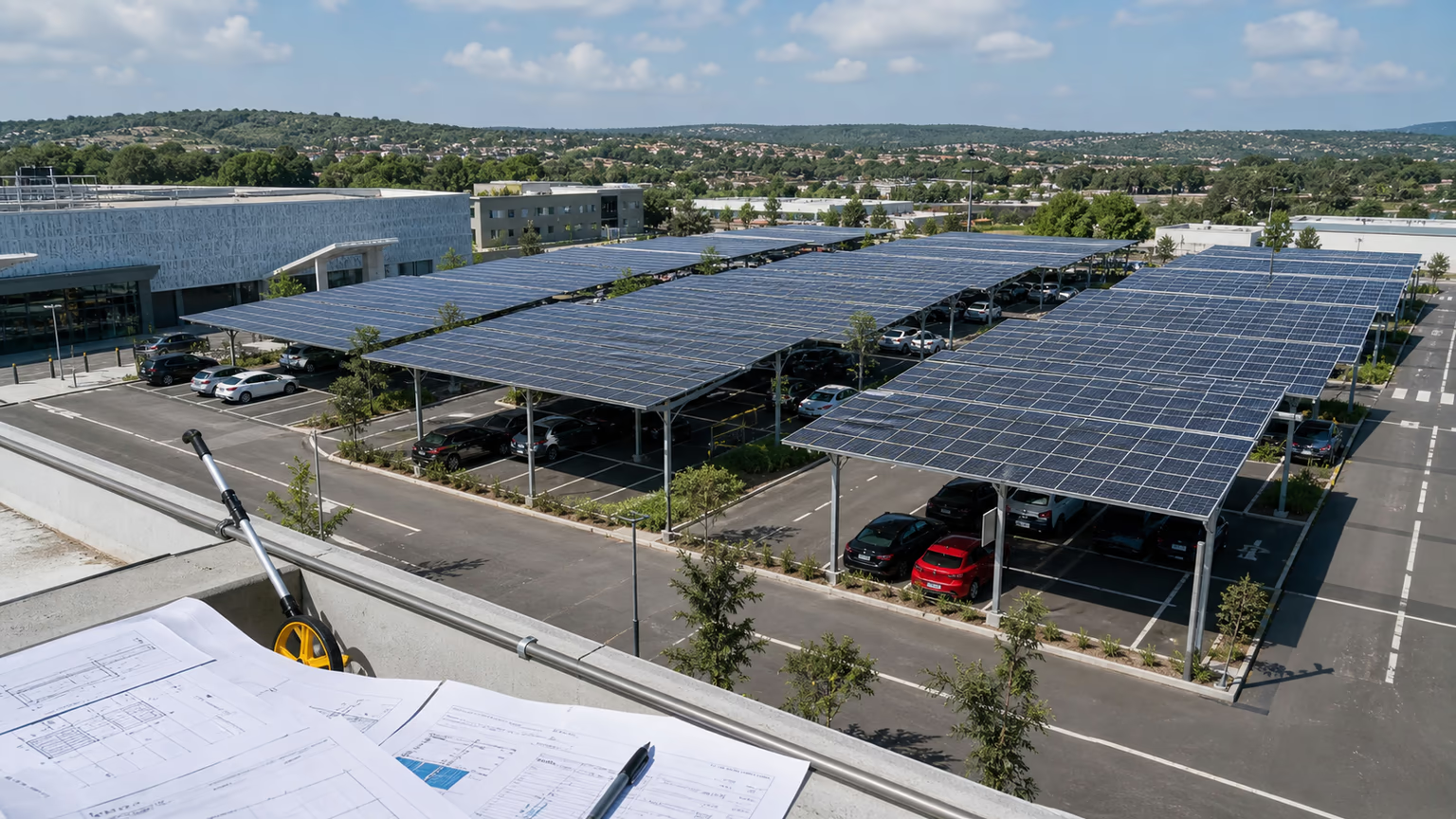
Short answer. In October 2026 there is no UK law requiring solar canopies on car parks, new or existing. The government consulted on mandating canopies on new outdoor car parks in England in 2025, then announced on 21 May 2026 that the policy would not be taken further. What does apply to operators is a set of planning and building rules that encourage or facilitate solar: national planning policy, local plan energy policies, a permitted development right for canopies on non-domestic car parks in England, and — from 2027 — stricter energy standards for new buildings.
This is a clear difference with France, where the APER law requires outdoor car parks of more than 1,500 m², new and existing, to be covered on at least half their area by shading structures with renewable energy production (photovoltaique.info). Some German states have their own solar obligations for car parks; the UK has nothing comparable.
The 2025 call for evidence — and its outcome
The Department for Energy Security and Net Zero ran a call for evidence on solar on car parks and electric vehicle charging from 7 May to 18 June 2025. Section 1 asked whether solar canopies should be required on new outdoor car parks. On 21 May 2026, the department published an update stating that, after analysing the responses, this policy will not be taken further at this point (gov.uk). The EV charging section received a separate government response in November 2025.
So any article or sales pitch presenting a “UK car park solar obligation” as law, or as imminent, is out of date.
What does apply in 2026
National Planning Policy Framework (England)
The NPPF revised in December 2024 asks local planning authorities to give significant weight to the benefits of renewable and low-carbon energy generation and to a proposal’s contribution to net zero when deciding applications (NPPF on gov.uk). It is a material consideration that helps a canopy application, not an obligation to build one.
Local plan policies
Local plans set their own energy and carbon policies for new development. In Greater London, for example, London Plan Policy SI 2 expects major development to be net zero-carbon, following an energy hierarchy whose “be green” step maximises on-site renewable energy, with a minimum on-site reduction beyond Building Regulations and an energy strategy submitted with the application. These policies apply to development proposals generally — they do not specifically require canopies on car parks — but a canopy can contribute to meeting them. Check your council’s adopted local plan and any supplementary guidance.
Permitted development for canopies on non-domestic car parks (England)
Since 21 December 2023, Class OA of Part 14 of the GPDO allows the installation of a solar canopy on an area lawfully used as off-street parking, other than for a house or a block of flats (SI 2023/1279). Main limits and conditions:
- no part higher than 4 m above ground, or within 10 m of the curtilage of a house or block of flats;
- not within the curtilage of a listed building or on a scheduled monument;
- no advertisements on the canopy;
- a prior approval application to the council (siting, design, external appearance, in particular glare for neighbours);
- completion within 3 years and removal when no longer needed.
Larger or taller schemes, or those outside these limits, need a planning application. Scotland, Wales and Northern Ireland have their own regimes. See also the Planning Portal guidance.
Future Homes and Buildings Standards (England, from 2027)
The Building Regulations etc. (Amendment) (England) Regulations 2026 (SI 2026/335) were laid in March 2026 and come into force a year later, with transitional arrangements. For new non-domestic buildings, the “notional building” used to set the energy target includes solar panels equivalent to 40% of the ground floor area. This is a performance benchmark for new buildings, not a requirement to fit canopies on car parks, and it does not apply to existing sites.
Grid connection
Every PV installation must be notified to or approved by the Distribution Network Operator (DNO). Small installations up to 16 A per phase follow the G98 “connect and notify” route; larger ones, which includes most car park canopies, need prior approval under G99 (MCS guidance). For larger projects, Ofgem approved a reform of the connection queue on 15 April 2025, moving from “first come, first served” to prioritising projects that are ready and needed (Ofgem decision). Connection timescales and costs depend on the local network: ask the DNO early.
SEG, MCS and VAT for commercial sites
- Smart Export Guarantee: covers solar PV up to 5 MW; suppliers set their own rates, which must always be above zero (Ofgem). For installations up to 50 kW, MCS certification (or an equivalent scheme) is required; above 50 kW, check the evidence your SEG supplier accepts.
- VAT: the zero rate on energy-saving materials applies to installations in residential accommodation and, since 1 February 2024, buildings used solely for a relevant charitable purpose, until 31 March 2027 (HMRC Notice 708/6). A canopy on a commercial car park is generally standard-rated; VAT-registered businesses usually recover the input VAT in the normal way.
Production and economics
There is no single “UK yield per m²” that applies everywhere: it depends on location, orientation, tilt, shading and module efficiency. For a first estimate, use the European Commission’s free PVGIS tool, then refine with your installer.
The economics of a car park canopy rest mainly on self-consumption: sites with high daytime demand (retail, logistics, offices, hospitals) value each kWh at their purchase price, while exported kWh are valued at the SEG or PPA rate. Payback therefore varies widely from one site to another and should be calculated with your own consumption profile and tariffs.
Net Zero context
The UK’s legally binding target of net zero greenhouse gas emissions by 2050 comes from the Climate Change Act 2008, as amended in 2019 (SI 2019/1056). Many public bodies have their own commitments — for example, NHS England aims for net zero for the emissions it controls directly by 2040. These targets create a policy direction and internal pressure to use estate land, including car parks, for on-site generation, but they are not a legal obligation on individual car park operators.
How Sunrak supports UK operators
Sunrak designs and supplies the metal canopy structure only (anodised aluminium 6063-T5 or galvanised steel Z275, stainless fasteners), delivered ready to assemble with instructions. We do not supply panels or inverters, carry out installation or grid connection, or prepare planning or prior approval applications.
The paid structural study, ordered before the equipment quotation, includes:
- Applicable assumptions and wind/snow checks for the site
- Dimensioned general arrangement drawing and layout plan
- Foundation or anchorage principle based on the data you provide
- Bill of materials and assembly instructions
- One round of corrections within the initial scope
You can attach these documents to a planning or prior approval application prepared by you or your consultant. Delivery takes 7 to 9 weeks after the equipment order, manufacturing and transport included, and the structure carries a 20-year structural warranty.
FAQ — UK car park solar canopy obligations 2026
Is there a national law mandating solar canopies on UK car parks?
No. The government consulted in 2025 on requiring canopies on new outdoor car parks in England, and announced on 21 May 2026 that the policy would not be taken further at this point. Planning policy and local plans encourage renewable energy, but there is no equivalent of France's APER law.
Does the London Plan require solar on my car park?
Not specifically. London Plan Policy SI 2 applies to major development: it expects net zero-carbon development, an energy strategy and the maximisation of on-site renewable energy. A canopy can help a major scheme meet that policy, but the plan does not impose canopies on car parks as such. Check with your borough how the policy is applied.
How do councils assess renewable energy in an application?
For major developments, councils commonly ask for an energy or sustainability statement showing how the local plan's carbon and renewable energy policies are met. The exact requirements depend on the local plan.
What is the role of MCS certification?
MCS certifies installers and products for installations up to 50 kW; for those, it is a condition of SEG export payments. Larger car park installations are outside the MCS scope; check with your SEG supplier what evidence it requires. Neither MCS nor SEG imposes a particular structural design.
Can I claim 0% VAT on a car park canopy and PV?
Generally not for a commercial car park: the zero rate is limited to installations in residential accommodation and buildings used solely for a relevant charitable purpose, until 31 March 2027. VAT-registered businesses usually recover input VAT through their VAT returns.
How long will the DNO connection take?
It depends on the size of the installation and on local network capacity. Small systems up to 16 A per phase are notified after installation (G98); larger ones need DNO approval before connection (G99), and timescales vary by region. Contact the DNO early in the project.
How long does a canopy project take?
For the Sunrak structure, delivery takes 7 to 9 weeks after the equipment order, manufacturing and transport included. The other stages — study, prior approval or planning, grid connection, installation by your contractor — vary from project to project and are not under Sunrak's control.
What is the typical UK payback period?
There is no reliable single figure: it depends on the share of electricity consumed on site, your tariff, the export rate, the installation cost and local yield. Model it with your own consumption data and a PVGIS or installer production estimate.
Further reading: