Anodised aluminium or galvanised steel: which material for a solar structure
Technical comparison anodised aluminium 6063-T5 vs galvanised steel Z275 for solar carports, canopies and ground mounts: density, strength, stiffness, corrosivity categories, embodied carbon. Verdict per use case.
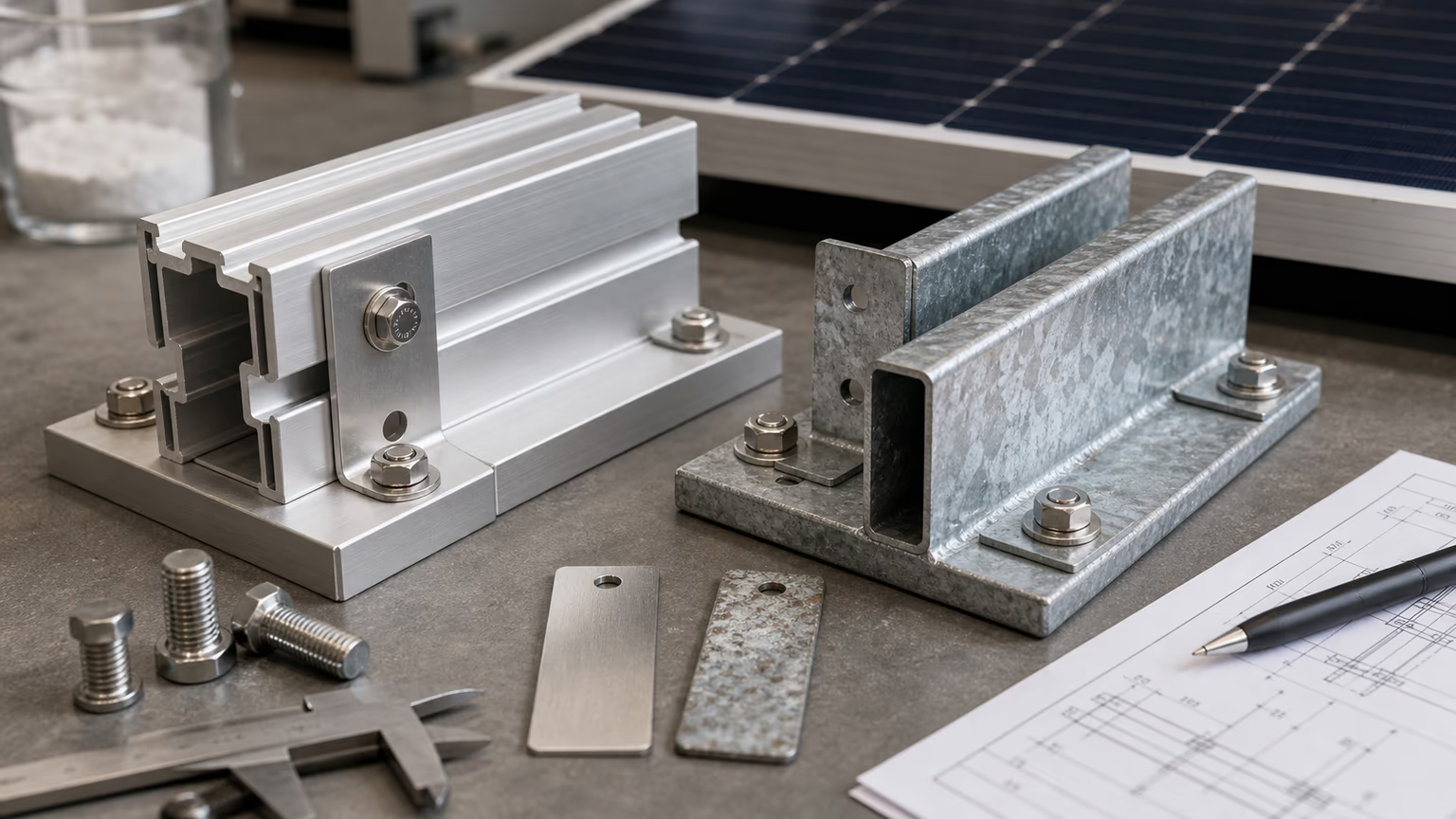
Once you have chosen metal (over wood) for your solar mounting structure, a second question arises: anodised aluminium or galvanised steel? The answer is not binary. Aluminium 6063-T5 anodised and galvanised steel Z275 have very different property profiles: density, stiffness, corrosion behaviour, cost structure, aesthetics, fatigue behaviour. Depending on your site (coastal UK, Highland Scotland, inland England) and use case (residential vs commercial), one material usually suits better than the other.
This article compares both materials across 8 criteria, using standard or published values where they exist, and gives a verdict for typical UK use cases.
The two materials in brief
Aluminium 6063-T5 anodised
Magnesium-silicon alloy widely used for architectural extrusions. T5 temper: cooled from the extrusion temperature and artificially aged. Anodising grows an oxide layer electrochemically; it protects against corrosion and gives a matt satin finish. Sunrak’s standard finish is 15 µm anodising.
- Density: 2.70 g/cm³ (about 1/3 of steel)
- Young’s modulus: 70 GPa
- 0.2% proof strength
fo(extruded profiles, EN 1999-1-1): 130 MPa for walls up to 3 mm, 110 MPa from 3 to 25 mm - Thermal expansion: 23 × 10⁻⁶ /K
Galvanised steel Z275
Structural steel strip coated by continuous hot-dip galvanising to BS EN 10346, then formed into sections. “Z275” means a minimum of 275 g/m² of zinc in total for both faces, i.e. roughly 20 µm per face. Standard for outdoor use in low-to-moderate corrosivity environments.
- Density: 7.85 g/cm³ (about 3× aluminium)
- Young’s modulus: 210 GPa (3× aluminium)
- Yield strength: depends on the grade, e.g. 250 MPa (S250GD) to 350 MPa (S350GD); 235–275 MPa for common hot-rolled S235/S275
Comparison across 8 criteria
1. Strength-to-weight ratio
Yield (or proof) strength divided by density, in MPa per g/cm³:
| Material | Re/ρ |
|---|---|
| Aluminium 6063-T5 (fo 110–130 MPa) | 41–48 |
| Steel S275 | 35 |
| Steel S350GD | 45 |
Per kilogram, 6063-T5 is comparable to or somewhat better than common structural steels in strength — the advantage depends on the steel grade and the aluminium wall thickness. Its real benefit is low weight per part, which eases handling, transport and assembly.
2. Stiffness
Steel is 3× stiffer than aluminium (Young’s modulus). Per kilogram the two are almost identical (E/ρ ≈ 26 for both), so aluminium designs use deeper or wider profiles to limit deflection, and deflection or local buckling often governs aluminium sections.
3. Corrosion resistance
Durability depends on the atmospheric corrosivity category of the site (ISO 9223: C2 low, C3 medium, C4 high, C5 very high — coastal and industrial sites are typically C3 to C5).
For galvanised steel, ISO 9223 gives first-year zinc losses of about 0.1–0.7 µm/year in C2, 0.7–2.1 in C3, 2.1–4.2 in C4 and 4.2–8.4 in C5. Dividing Z275’s ~20 µm per face by these rates gives an indicative time before the zinc layer is consumed:
| Category | Z275 (~20 µm per face), indicative |
|---|---|
| C2 (most rural inland sites) | more than ~28 years |
| C3 (urban, mild coastal) | ~10–28 years |
| C4 (industrial, coastal) | ~5–10 years |
| C5 (very aggressive, sea front) | ~2–5 years |
This is a simplified estimate (cut edges, sheltered areas and local conditions change it), but it shows why Z275 alone is not suited to aggressive coastal sites: heavier batch galvanising or a duplex system (galvanising + paint) is then used.
For anodised aluminium, the anodic film thickness should match the exposure. Industry practice (e.g. Qualanod classes) generally reserves thicker classes — 20 µm and above, 25 µm for marine or severe industrial atmospheres — for aggressive environments. If your site is coastal, say so in the study brief: the material and finish are confirmed for that exposure before ordering.
4. Cost
Steel is cheaper per kilogram than aluminium, but aluminium parts weigh about a third as much for similar sections. Total cost also depends on finish, connection details, foundations and transport. Compare quotations for the same design loads and the same corrosivity category, not prices per kilogram.
5. Weight, transport and assembly
Lighter aluminium parts are easier to handle on site without lifting equipment and reduce transport weight. Steel’s higher stiffness can allow slimmer sections or longer spans for the same depth. Foundation size is mainly driven by wind uplift and overturning, not by the self-weight of the frame.
6. Aesthetics
Anodised aluminium has a satin matt look that suits modern architecture; anodising can also be coloured. Raw galvanised steel has an industrial-functional appearance; a paint or powder coat can be applied where appearance matters.
7. Recyclability and embodied carbon
Both metals are widely recycled. Recycling aluminium is commonly quoted as needing only around 5% of the energy of primary production, while primary aluminium has a much higher carbon footprint per kilogram than steel, strongly dependent on the electricity used for smelting. For steel, worldsteel reports a global average of about 1.9 t CO₂ per tonne of crude steel (2023). If embodied carbon matters for your project, ask for the supplier’s environmental product declarations (EPDs) and recycled content.
8. Fatigue performance
For comparable details, steel has markedly higher fatigue resistance than aluminium (the fatigue design curves of EN 1999-1-3 sit well below those of EN 1993-1-9). This matters for canopies exposed to frequent strong winds, such as the west coast of Scotland and the Outer Hebrides.
Verdict by use case
| Use case | Recommendation |
|---|---|
| Residential carport, temperate inland UK | Anodised aluminium 6063-T5 or galvanised steel Z275 |
| Residential carport near the coast (UK / Ireland) | Anodised aluminium, with a finish suited to the exposure |
| Agricultural structure (livestock, ammonia, humidity) | Assess the corrosivity category first; aluminium or heavier protection than Z275 |
| Commercial car park canopy inland | Galvanised steel Z275 (coated if appearance matters) |
| Coastal or high-wind exposed car park | Mixed: steel posts + aluminium rafters, with corrosion protection matched to the site |
| Large solar farm ground mounting | Galvanised steel |
| Visible structure near a listed building | Finish and colour agreed with the planning or conservation officer |
FAQ
Does aluminium resist UK coastal salt air?
Anodised aluminium generally performs well near the sea, provided the anodic film thickness suits the exposure (thicker classes, typically 20–25 µm, are usually specified for marine atmospheres). Z275 galvanised steel alone is not recommended in very aggressive coastal conditions, where its thin zinc layer can be consumed within a few years.
Is there a more corrosion-resistant galvanised option than Z275?
Yes. Heavier continuous coatings (Z350, Z450, Z600 under BS EN 10346), batch hot-dip galvanising to BS EN ISO 1461 (minimum mean thickness 55–85 µm depending on steel thickness), or a "duplex" system: galvanising plus a paint or powder coating.
What is the Sunrak warranty for each material?
A 20-year structural warranty, under Sunrak's warranty conditions, for both anodised aluminium 6063-T5 and galvanised steel Z275. Declare a coastal or otherwise aggressive environment in your brief so the material and finish are chosen for it.
Is mixing aluminium and steel feasible?
Yes, often a good option for exposed canopies: steel posts (stiffness, fatigue) + aluminium rafters (lightness). Galvanic isolation is required at contact surfaces (insulating washers, pads or coating) to prevent corrosion.
Which material best integrates an EV charger?
Neither material changes the electrical design. The charger cable is routed in suitable external conduit or trunking fixed to the structure, designed and installed by the electrician to BS 7671. Sunrak profiles do not include an integrated cable channel, and any drilling of structural profiles must be agreed beforehand because it can affect capacity and corrosion protection.
Galvanised steel in agricultural / livestock buildings?
Livestock buildings combine humidity and ammonia, which can put them in a high corrosivity category. Z275 is then usually insufficient: assess the category and choose either aluminium, heavier galvanising or a duplex system, or stainless steel for critical parts.
What if I am in Highland Scotland with extreme wind exposure?
The far north and west of Scotland have some of the highest basic wind velocities on the UK National Annex map, before altitude and orography effects are added. A hybrid structure — galvanised steel posts for stiffness and fatigue, anodised aluminium rafters — is worth considering, with anchorages sized for uplift.
Further reading: