Free solar carport in the UK: scam or real offer? The 7 pitfalls to know in 2026
Free solar carport or panels in the UK: distinguishing scams from real offers. Rent-a-roof schemes, hidden finance, doorstep selling — 2026 guide to the real support schemes (0% VAT, SEG, Warm Homes grants) and how to judge the long-term balance.
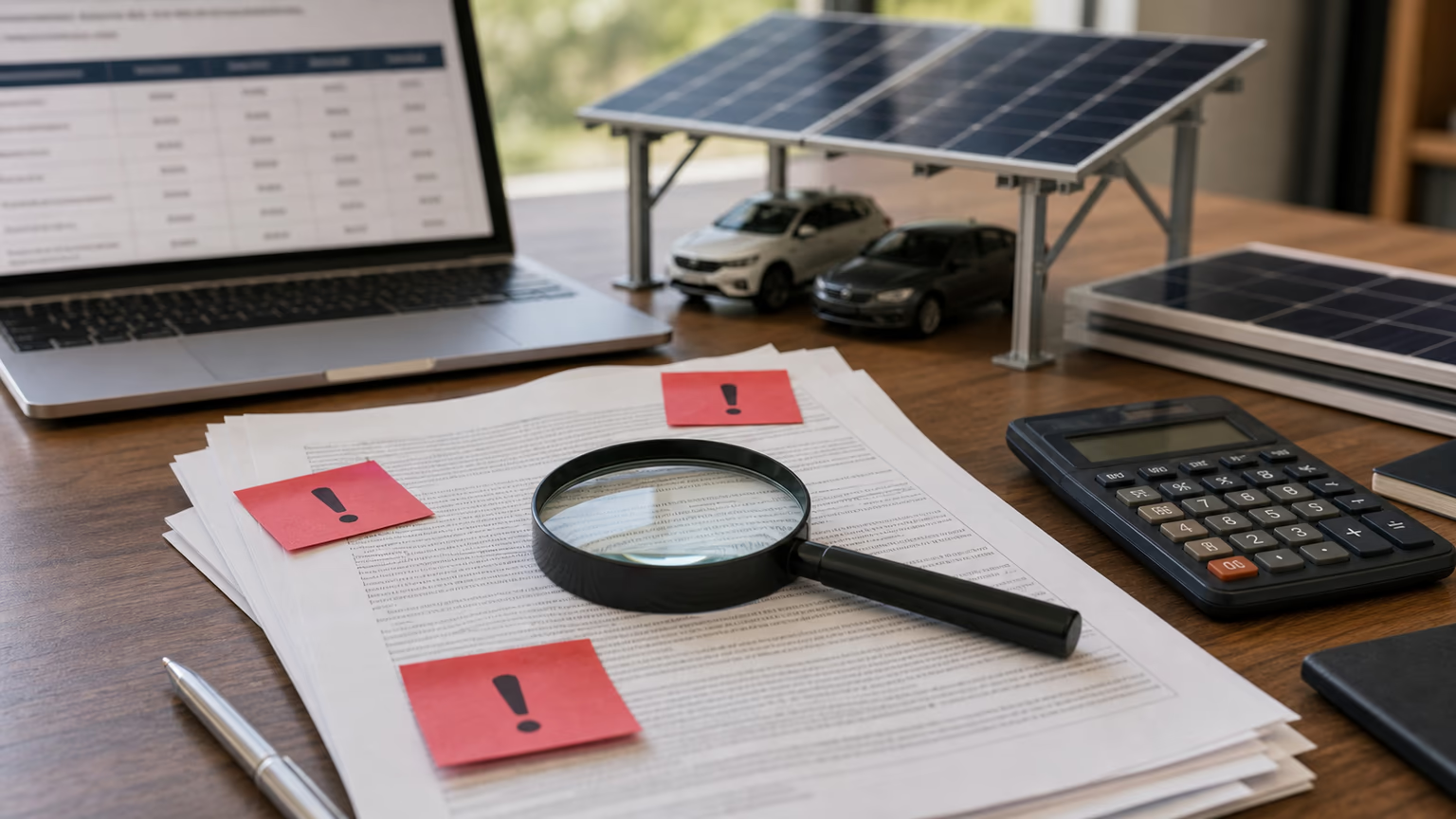

“Free solar carport funded by government grant!” “Solar panels for £1!” “Self-funding install, you pay nothing!” Messages like these circulate on social media and through cold calls. Behind some of them sit credit agreements, long leases or installations of uncertain quality.
This article — with no sponsored content — explains what is actually behind “free” solar carport offers, identifies the 7 most common pitfalls, and lists the real support schemes that exist in 2026, with links to the official sources so you can check them yourself.
The economic truth: a solar carport cannot be free
A solar carport combines several items, each with a real cost:
- the carport structure (designed for your site’s snow and wind loads);
- the solar panels;
- the inverter (and any battery);
- electrical work, protection devices and grid notification to the network operator;
- installation by a competent installer.
For scale, the government’s Warm Homes Plan announcement of 20 January 2026 put the average cost of a full home solar installation including a battery at £9,000 to £12,000 — before any carport structure. No company gives this away. “Free” offers always hide an economic counterpart: credit, a lease, or income you give up.
The 7 pitfalls of “free” offers
Pitfall 1 — Hidden consumer credit
The usual script:
Cold call or doorstep visit. “£0 thanks to a government grant + 0% VAT”. You sign a “reservation document”. Later, a long-term consumer credit agreement appears, whose total repayable amount is far higher than the installation price.
How to spot it: any mention of “monthly payment”, “finance partner”, “APR” or “credit” → not free. Check that the lender and any credit broker are authorised on the FCA register. For most regulated credit agreements you can withdraw within 14 days without giving a reason (Consumer Credit Act 1974, s.66A), repaying any credit drawn.
Pitfall 2 — Inflated ECO4 funding
ECO4 (Energy Company Obligation) is a real scheme, but it targets low-income and vulnerable households, mainly for insulation and heating. Solar PV has only been fundable in limited cases (typically homes with electric heating). The government has extended ECO4 to 31 December 2026 to let suppliers finish existing targets, and has stated there will be no successor supplier obligation (government response, January 2026). Funding through ECO4 is therefore increasingly limited.
How to spot it: anyone promising a large ECO4-funded solar installation to an ordinary household is misrepresenting the scheme. Ask which obligated supplier is funding the measure and check Ofgem’s ECO pages.
Pitfall 3 — The rent-a-roof deception
Rent-a-roof was mainly a Feed-in Tariff (FiT) era model: a company installed panels for free, kept the FiT payments, and the homeowner got free use of the electricity generated, under a lease often running 20–25 years. The FiT scheme closed to new applicants on 31 March 2019, and Which? notes that very few free-panel schemes remain — but many leases are still running.
Known traps:
- the lease binds the property and future buyers; some mortgage lenders have refused or restricted lending on homes with such leases;
- you give up the generation and export income for the lease term;
- the contract may restrict alterations or roof works, or charge for lost income;
- if the operator disappears, maintenance responsibilities can become unclear.
How to evaluate: have the lease reviewed by a solicitor, check with your mortgage lender before signing, and check the operator’s history on Companies House.
Pitfall 4 — Bogus “government grant” claims
Some sellers invent a “government solar grant” to justify free claims. There is no universal solar grant for homeowners. The real schemes in 2026:
- 0% VAT on the installation of solar panels in residential accommodation, until 31 March 2027 (then 5%) — a tax relief, not a grant (HMRC Notice 708/6);
- Smart Export Guarantee (SEG): payment for exported electricity, at rates set by each supplier (Ofgem);
- Warm Homes: Local Grant (England): delivered by councils for households usually on £36,000 a year or less (or on certain benefits / in eligible postcodes) in homes rated EPC D to G; solar panels can be among the measures (gov.uk);
- Warm Homes Plan: announced in January 2026 with government-backed low or zero-interest loans for solar, batteries and heat pumps; the government said loan details would follow later — check gov.uk for the current status (press release);
- ECO4: low-income households only, until 31 December 2026 (above).
The Boiler Upgrade Scheme funds heat pumps and biomass boilers, not solar panels (gov.uk). Scotland, Wales and Northern Ireland run their own schemes: check the official advice services there.
How to spot it: ask for the scheme name and the gov.uk page, and check it yourself — never via a link sent by the seller.
Pitfall 5 — Non-MCS-certified installer
For SEG export payments on installations up to 50 kW, the installation must be MCS-certified (or certified under an equivalent scheme). Without it you may not be able to claim export payments, and some insurers or lenders may ask for the certificate. The 0% VAT relief itself does not depend on MCS: it depends on the supply being an installation of qualifying materials in residential accommodation.
How to spot it: ask for the installer’s MCS number and check it on mcscertified.com.
Pitfall 6 — Hollow “25-year warranty”
“25-year warranty” is heavily used. But who guarantees what?
- Panel product and performance warranties: given by the manufacturer — check the durations and output percentages on the datasheet;
- Workmanship: MCS requires certified installers to give domestic customers a workmanship guarantee of at least 2 years, insurance-backed and transferable to a new owner;
- Structure warranty (carport): ask who gives it, for how long, and what it covers.
A “25-year warranty” without specifying what and by whom is worth little if the company disappears.
Pitfall 7 — Shell company carousel
You sign with one company, another installs, a third services the system — with no contractual link between them. Some operators cycle short-lived companies to avoid long-term obligations.
How to spot it: check on Companies House that the contracting company has a trading history, filed accounts and identifiable directors, and look at the directors’ other appointments (a pattern of dissolved companies is a warning sign).
The real incentives — and how to judge the long-term balance
A well-designed PV installation can pay for itself over its life, but only after a real initial investment. To judge an offer, do the calculation with your own figures:
- Installation cost — itemised quote (structure, panels, inverter, electrical work, installation).
- 0% VAT — applies to the installation in residential accommodation until 31 March 2027. Materials bought on their own, without installation, are standard-rated. Whether a carport structure forms part of a single zero-rated installation supply is a question to settle with the installer (and, if in doubt, HMRC) before you sign.
- Self-consumption savings — kWh you use directly × your electricity unit rate.
- Export income — kWh exported × your SEG tariff (rates vary widely between suppliers; SEG rates must always be above zero).
- Production estimate — ask the MCS installer for its estimate, or check it with the European Commission’s free PVGIS tool.
- Running costs — inverter replacement, cleaning, insurance.
If an offer only works with a “grant” that you cannot find on gov.uk, it does not work.
Verify a legitimate offer in 5 minutes
1. Request an itemised quote (structure, panels, inverter, installation, grid notification).
2. Check MCS certification at mcscertified.com.
3. Check any claimed grant on gov.uk or Ofgem, by searching the scheme name yourself.
4. Verify the company on Companies House (age, accounts, directors) and any lender on the FCA register.
5. Don’t sign under pressure. For contracts signed away from business premises or at a distance, you generally have a 14-day cancellation period (Consumer Contracts Regulations 2013). Misleading and aggressive sales practices are prohibited under the Digital Markets, Competition and Consumers Act 2024, which replaced the Consumer Protection from Unfair Trading Regulations 2008 from 6 April 2025.
The Sunrak philosophy
Sunrak sells bespoke metal structures, not “free kits” — and only the structure: no panels, inverter, electrical connection, installation or planning application. A paid structural study comes first; the equipment quotation that follows lists the structure’s components. We do no cold calling. The structure carries a 20-year structural warranty.
FAQ — Free solar carport UK scams and real incentives
Do £1 solar panels really exist in the UK?
Not for typical homeowners. "£1 solar" offers usually mask consumer credit or a lease that surrenders years of energy income. The only genuinely free installations are those funded by official schemes for eligible low-income households, arranged through councils or obligated suppliers — not through cold calls.
Can my installation really net £0?
Over its life, a well-designed installation can recover its cost through electricity savings and export payments, helped by 0% VAT on residential installations until 31 March 2027. But there is a real initial investment, and the balance depends on your consumption, tariff and production. Instant zero cost does not exist legitimately.
Real grants available in 2026?
0% VAT on residential installations (until 31 March 2027) and SEG export payments apply widely. Means-tested support exists through the Warm Homes: Local Grant in England and ECO4 until 31 December 2026; the Warm Homes Plan announced government-backed loans whose details were still to be published. No universal solar grant exists for the average UK homeowner.
What if I'm a solar scam victim?
(1) Contact the Citizens Advice consumer helpline on 0808 223 1133, which can pass the case to Trading Standards. (2) If the installer belongs to a consumer code (RECC or HIES) or is MCS-certified, use their complaint procedures. (3) For finance problems, complain to the lender, then to the Financial Ombudsman Service; if the purchase was financed by a linked credit agreement or credit card, the lender may share liability under section 75 of the Consumer Credit Act. (4) Take legal advice for misrepresentation or breach of contract; the Consumer Rights Act 2015 also protects you.
Is rent-a-roof viable?
New rent-a-roof offers are now rare. If you are offered one, or are buying a home with an existing lease, have the lease checked by a solicitor and confirm with your mortgage lender. For most homeowners, owning the system and using the electricity is simpler.
Does ECO4 cover solar PV?
Only in limited cases, for eligible low-income households, mainly with electric heating. ECO4 ends on 31 December 2026 with no successor supplier obligation. "Free solar via ECO4" offered to ordinary households is misleading.
Does Sunrak offer "free carports"?
No. We sell bespoke metal structures designed for the site's wind and snow loads, at quoted prices. No cold calling and no "miracle offers". The paid structural study comes first, and its fee is credited in full against the structure if the structure is ordered within 90 days for the same site and scope, and the equipment order (excluding VAT) is at least five times the study price.
What is the cooling-off period?
Generally 14 days for distance and off-premises (e.g. doorstep) contracts under the Consumer Contracts Regulations 2013. For contracts signed in a trader's premises there is usually no statutory cooling-off period. Read the contract carefully before signing.
Further reading: