Heavy duty cantilever racking, made to measure, indoors or outdoors under a roof.
Tube, steel sections, timber, sheet materials: cantilever racking stores long loads on arms that project from a column, with no front upright in the way of the forklift. Sunrak designs it for what the catalogue does not cover: long spans, high arm capacities, galvanised outdoor cantilever racking, with a roof or a solar roof. You receive a free quote with a layout drawing.
- Free quote, no obligation
- Layout drawing to your dimensions
- Drawings, sketches and photos welcome
Free, no obligation
Describe your stock, get a drawing and a price.
No payment, no commitment. The more precise the length, weight and shape of your packs, the more accurate the layout drawing will be from the first version.
We kept what you had already entered.
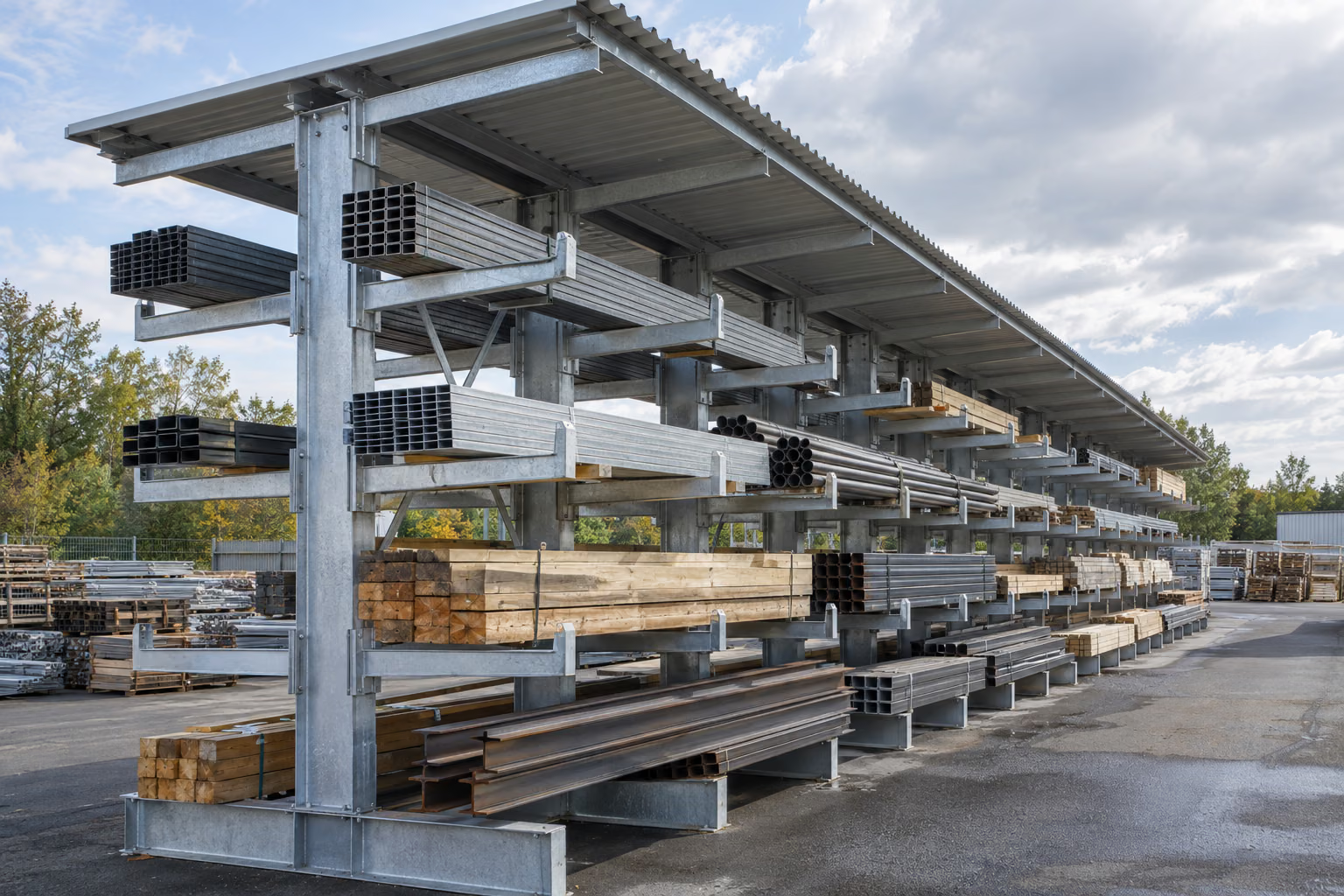
Six decisions behind safe cantilever racking.
Cantilever racking works by leverage: each arm passes its load into the column, then into the base and the slab. The layout drawing settles these six points before we price anything.
Single or double sided
Single-sided runs sit along a wall or the edge of a yard. Double-sided runs stand in the middle, load from both faces and double the capacity per metre run. The choice follows your aisles and forklift routes.
Arm and column capacity
These are the two figures that matter. Arm capacity depends on arm length and section; column capacity on how many arms are loaded and how high. The design limits arm deflection under load: an arm that visibly bends is under-specified.
Load length and column centres
A long load must rest on at least two arms, without sagging between them or overhanging too far at the ends. Column centres follow the length and stiffness of what you store: a 12 m tube does not sit like a pack of sawn timber. Give us real lengths and weights and we work out the centres.
Inclined arms and end stops
For tube and bar, arms angled slightly towards the column or end stops at the arm tip stop loads rolling off. For boards and flat packs, arms stay level. The type of stop is chosen with your stock.
Anchoring and slab
The base resists the overturning of the whole column. It is anchored into a slab or onto concrete pads. The drawing gives the forces at the foot of each column, so you can check your ground, especially outdoors, where a tarmac yard is not always enough.
Corrosion protection
In a dry building, a paint finish is enough. Outdoors, the structure is galvanised, and the protection process is stated on the quote. Coastal site, industrial air, road salt: tell us, as protection is chosen for how aggressive the site is.
For a few standard bays, an online shop will be quicker.
Light indoor cantilever racking is sold online: standard bays, published prices, configurators and fast delivery. If you need two or three catalogue bays to store bar in a workshop, that is the simplest route, and we will tell you so.
Sunrak works where the catalogue stops: heavy duty cantilever racking for packs of several tonnes per level, long arms, tall columns and runs of several tens of metres; outdoor cantilever racking in galvanised steel for builders’ merchants and sawmills; and above all roofed cantilever racking, with steel roof sheeting or solar panels. Steel structures that carry solar modules are where Sunrak started.
For pallets rather than long loads, see our pallet racking. To gain floor space inside a building, a mezzanine floor. To cover a whole storage yard, a steel building.
Which cantilever racking for which job?
These options combine: a double-sided outdoor run can take a roof, a single-sided run can be clad at the back. The layout starts from your stock and your site.
| Configuration | Typical use | Worth knowing |
|---|---|---|
| Single sided | Along a wall or a yard boundary | Never leans on the wall: column and base are free-standing and anchored to the ground. |
| Double sided | In the middle of a yard or warehouse, loaded from both faces | Load both faces evenly; the design also covers one face full and the other empty. |
| Outdoor, galvanised, no roof | Sections, tube, materials that tolerate rain | Anchored to a slab or pads; wind on the stored loads must be allowed for. |
| Outdoor with sheeted roof | Timber, boards, anything that must stay dry | The roof takes wind and snow: the whole structure is designed for it. |
| With a solar roof | Same use, plus on-site electricity | Roof pitch and orientation, module weight and cable routes are fixed at drawing stage. |
If you do not know the exact weight of your packs, give us their size and material and we will estimate it with you.
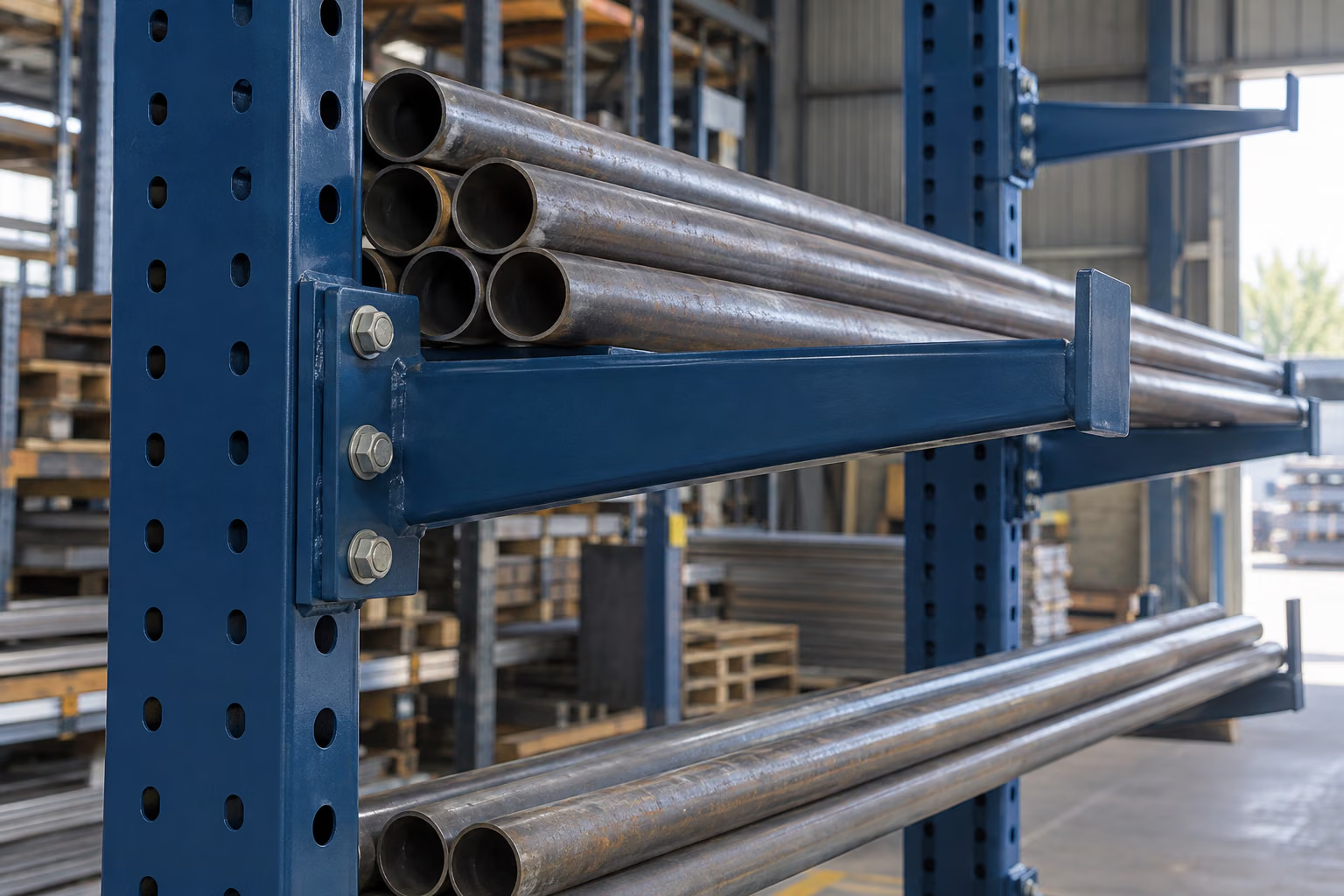
Arm, stop and bolts: where safety is decided.
Each arm is bolted to the column and can be moved up or down to suit your stock. The end stop holds tube and bar; inclined arms do the same without an extra part. Tell us the shape of your loads and how you place them (counterbalance truck, sideloader, overhead crane), and we choose arms and stops to match.
A roof changes the design of the whole structure.
Without a roof, cantilever racking mainly carries its stock. With one, it becomes a structure exposed to wind, which pushes and lifts the sheeting, and snow, which builds up on the roof. These actions are worked out under Eurocode 1 (BS EN 1991-1-3 for snow, BS EN 1991-1-4 for wind) and the UK National Annex, from the site’s location, altitude and exposure. We give no values here: they depend on where you are.
The usual roof is profiled steel sheeting on purlins, with an overhang that keeps driving rain off the stock. A single-sided run can also be clad at the back.
With solar panels, the structure also carries the weight of the modules and their fixings, and pitch and orientation are chosen for output. Sunrak already designs solar carports and solar canopies; a solar-roofed cantilever follows the same principles. The electrical connection is for a qualified electrician.
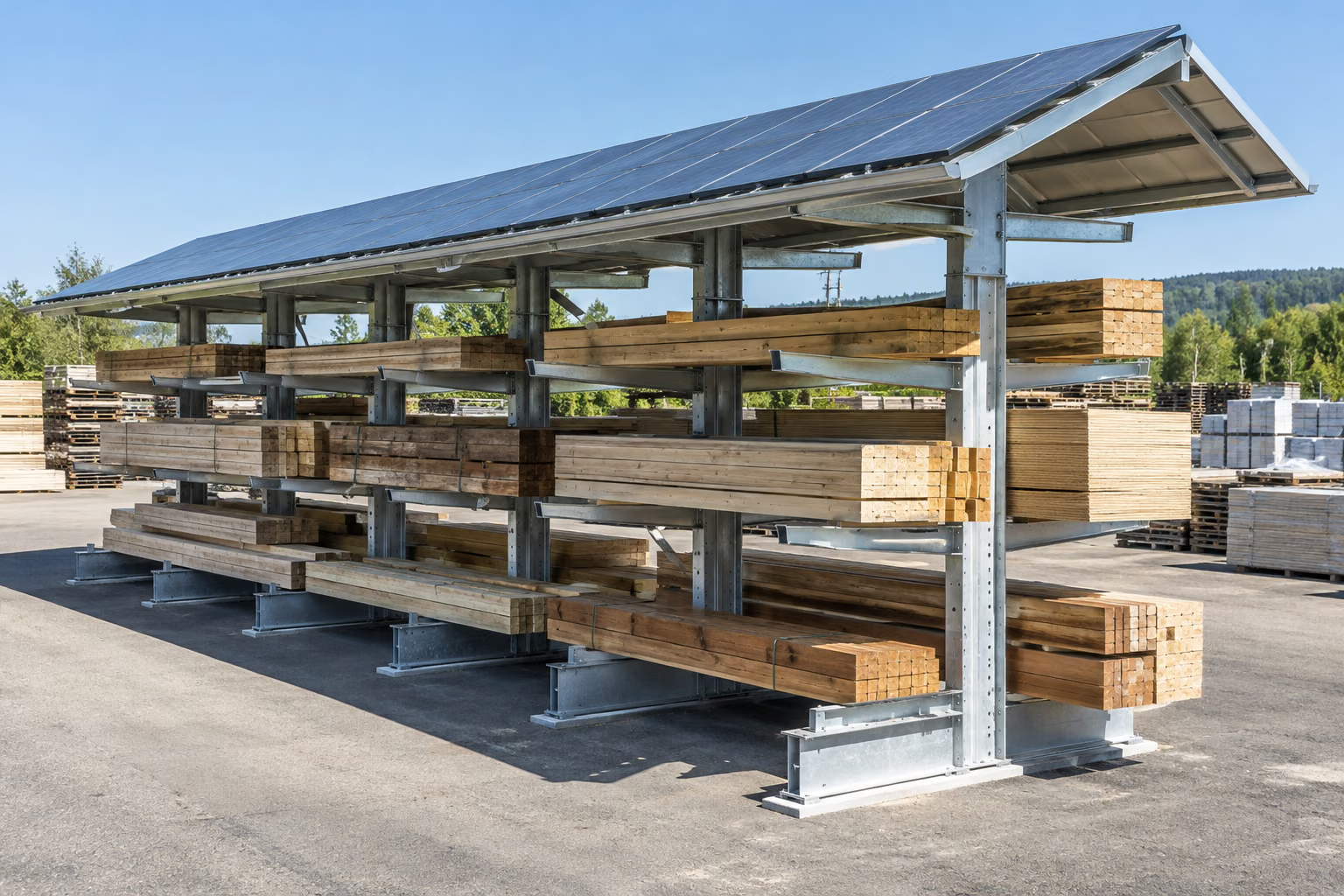
Your timber store can generate electricity too.
A roofed cantilever run offers a large roof area, often well oriented and unshaded. Tell us if you are considering panels, even for later: structure, purlins and pitch are planned from the start. Adding them afterwards is rarely simple.
Load notices, inspection and planning.
Inspection. HSE guidance on PUWER regulation 6 says work equipment exposed to conditions causing deterioration should be inspected at suitable intervals, and after events that could affect safety, by someone with enough knowledge and experience of it. The result should be recorded and kept at least until the next inspection. Racking loaded and unloaded by forklifts is a typical case.
Industry practice. BS EN 15635 is the reference standard for the use and maintenance of steel storage equipment. SEMA, the UK storage equipment manufacturers’ association, runs the SEMA Approved Racking Inspector (SARI) scheme for expert inspections and offers cantilever racking safety training. Display arm and column capacities on every run and take any bent arm out of use. Steel stockholders will also find HSE guidance HSG246 on storing and handling metal stock useful.
Design. EN 15512, the design standard for pallet racking, expressly excludes cantilever racks from its scope. Ask any supplier which method their design is based on. EN 15629, used to specify storage equipment, does cover cantilever racking.
Planning. A roofed outdoor cantilever run may count as a building. Planning permission and Building Regulations may apply depending on its size, height and location: check with your local planning authority before ordering.
Sources : HSE, Inspection of work equipment (updated 29 October 2024) ; SEMA, Find a SEMA Approved Racking Inspector ; SEMA, Cantilever racking safety awareness ; HSE, HSG246 Safety in the storage and handling of steel and other metal stock ; EVS, scope of EN 15512:2020 ; EVS, scope of EN 15629
What Sunrak supplies, and what it does not.
- The free quote, with a dimensioned layout drawing based on your stock and your site.
- The made-to-measure structure (columns, bases, arms, stops, bracing), painted or galvanised, with roof sheeting or a frame for solar panels as ordered, delivered with assembly instructions.
- The manufacturer’s certificates, sent with the quote.
- Installation: we do not install in the UK. The racking arrives ready to assemble with instructions and is erected by the contractor you choose.
- Planning applications and Building Regulations approval.
- Slab, concrete pads and ground investigation where bearing capacity is unknown.
- Periodic racking inspections in use.
- Electrical connection of a solar roof.
From your stock to installed cantilever racking.
Your stock and your site
Length, weight and shape of packs, number of levels, indoors or outdoors, roof: the form takes two minutes. A photo of the site helps a lot.
Layout drawing and price
Column centres, arm length, allowable loads and ground forces, with the price of the structure.
Adjustments
Level heights, stops, roof overhang, pitch for panels: the drawing is revised before you order.
Made to measure
Factory manufacture. Production and delivery lead times are confirmed on the quote.
Delivery
Delivered ready to assemble with instructions; erected by the contractor you choose.